Technical Overview
From transaction event to fraud decision in under 80ms.
A deep look at the ingest, signal extraction, scoring engine, and decision response that powers every Fraudhalo API call.
API Flow
Four stages. One round-trip.
Every fraud scoring request follows the same deterministic path through Fraudhalo's pipeline.
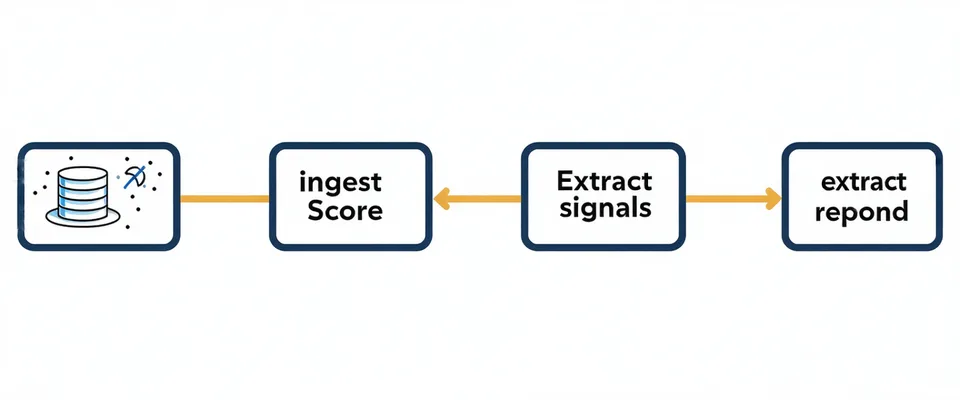
Transaction Event Ingest
A single HTTP POST to /v1/score carries the transaction payload: card hash, amount, merchant ID, IP address, device identifier, and optional enrichment fields. No raw PAN required.
POST /v1/score HTTP/1.1
Authorization: Bearer <api_key>

{
 "card_hash": "sha256:3f4a...",
 "amount_cents": 12750,
 "merchant_id": "mch_8d3b",
 "ip": "203.0.113.42",
 "device_id": "dv_f9c2"
}Signal Extraction
Fraudhalo extracts 40+ signals in real time across three categories: velocity patterns over 1m/5m/15m/1h windows, behavioral graph edges, and identity consistency signals.
# Extracted in real time
card_velocity_1h: 23
device_accounts_7d: 8
addr_consistency: 0.34
amount_pattern: "probe"Scoring Engine
A gradient boosting ensemble model combines the signals into a fraud probability score (0–100). The model is retrained weekly on confirmed fraud labels and dispute data.
# Score pipeline
model: "gbm_v3_2025w38"
features_used: 41
latency_ms: 62
Signal Architecture
Three signal categories.
Fraudhalo's detection logic draws from three independent signal families, each targeting different fraud patterns.
Velocity Signals
txn_count_1mTransaction frequency 1-minute windowcard_velocity_1hCards probed per houramount_patternAmount distribution anomalydecline_rate_5mDecline spike patterns
Behavioral Graph Signals
device_accounts_7dAccounts linked per devicedevice_graph_edgesDevice-account graph densitysession_entropySession behavior entropyip_account_overlapIP address account sharing
Identity Signals
addr_consistencyAddress consistency scorename_ssn_matchName-SSN correlation signalphone_linkagePhone number identity graphthin_file_indicatorThin credit file flag
Model Learning
How the model stays current.
Fraud patterns evolve weekly. Fraudhalo uses a champion-challenger retraining framework to keep detection accuracy high without disrupting production decisions.
Latency Benchmarks
Sub-100ms end-to-end.
Measured end-to-end from API receipt to response, in our us-east-1 region under representative production load conditions.
| Percentile | Latency (ms) | Notes |
|---|---|---|
| p50 (median) | 62ms | Typical well-formed request with full feature set |
| p75 | 71ms | Slightly elevated graph query complexity |
| p95 | 88ms | High-complexity identity graph lookups |
| p99 | 102ms | Worst-case new merchant fingerprinting |
| SLA target | 150ms | Hard SLA at p99 for Growth tier and above |
Network round-trip time from your infrastructure not included. Co-location in us-east-1 or us-west-2 recommended for latency-sensitive integrations.
Ready to integrate?
API documentation is available to pilot customers. Request a pilot to get your API credentials and full endpoint reference.
Request a Pilot